How Surfers Predicted Waves before Apps and Internet
Before surf apps and webcams, surfers read weather, tides and the ocean itself. A nostalgic look at how waves were found before the forecast feed.
By @shakanomad - 09 Nov 2026
Picture: Paige Thompson

Asking surfers who started decades ago how they knew there would be waves the next morning and, quite often, the answer begins with something like: someone had heard something. The wind had changed. A storm was moving across the Atlantic. A friend who lived near the coast had seen a few lines appearing on the horizon. The pressure was dropping. The tide would be right around sunrise. There was a feeling that it might be worth going.
And then they went.
Boards on the roof, wetsuits in the car, perhaps a thermos somewhere between the seats, and no certainty that anything worthwhile would be waiting at the end of the road.
For surfers who have learned the sport in the age of smartphones, it is difficult to imagine just how different that relationship with the sea once was. Today we can wake up, reach for a phone and know the swell height, period, direction, wind, tide and expected conditions before our feet touch the floor. We can open a live camera and watch the waves breaking in real time. If one beach looks bad, another forecast is only a few taps away.
There is nothing wrong with that. It is useful, efficient and often safer. But listen long enough to surfers who remember what came before and another side of the story begins to emerge. Before the ocean became a screen full of numbers, learning when to surf meant learning to observe.
When a forecast was something you pieced together
Modern surf forecasting has given the ocean a numerical language: 1.8 metres, 14 seconds, northwest swell, offshore wind until midday. Those numbers are incredibly useful once you understand what they mean. Years ago, however, many surfers had to assemble that information themselves from fragments.
Some followed weather charts. Some listened carefully to marine forecasts. Some watched what storms were doing several days away. Others had little interest in meteorology at all but knew their home coastline so intimately that subtle changes were enough to make them suspicious that something was coming.
An older surfer might remember that a particular wind usually meant a certain bay would clean up later in the day. Another knew that a swell arriving from slightly too far north would miss one reef almost entirely but wrap into another a few kilometres away. Tide tables mattered. Local wind mattered. Yesterday mattered.
The knowledge was rarely contained in one place.
It accumulated.
A bad session taught something. So did an unexpectedly good one. A storm seen on a chart became a swell several days later, and somebody remembered the connection. The next time a similar system appeared, the guess became a little more educated.
Surf forecasting was science, certainly, but at local level it was also memory.
The people who seemed to know
Every surf community appears to have had them: the people who somehow knew.
They were not necessarily meteorologists. They simply watched the sea constantly.
They noticed the direction of the wind before most people thought about it. They knew which swell angles reached which beaches. They understood how quickly a bank could disappear after a storm or how much water a particular reef needed before it started behaving properly.
The stories older surfers tell often have the same character. Somebody would say that tomorrow might be good. Nobody was entirely sure why they trusted him, but they did.
Sometimes he was right.
Sometimes everyone drove an hour to stare at a completely flat ocean.
That was part of it too.
The friend who lived near the beach
Before webcams, one of the most advanced pieces of surf technology was remarkably simple: a telephone and a friend with a view of the sea.
You called.
“How is it?”
And then came the interpretation.
“Not bad.”
What exactly did not bad mean?
Waist high and clean? Overhead and perfect? Terrible, but the person answering the phone wanted the beach to himself?
Information moved through friends, surf shops, cafés and car parks. A good bank could remain relatively quiet because knowledge still travelled at human speed. Someone surfed it in the morning, mentioned it to two friends later, and perhaps by the following day the word had spread.
Today a photograph can reach thousands of people before the surfer in it has taken off a wetsuit.
That difference alone has changed surf culture enormously.
When you could finally telephone the surf report
By the 1980s, technology was already beginning to change the ritual.
In Southern California, Surfline launched its 976-SURF telephone service in 1985. A surfer could call a number and hear information about conditions along the coast. From today’s perspective, a recorded telephone report sounds almost primitive. At the time, it was a revolution.
You no longer had to drive all the way to the ocean simply to discover what it was doing.
Later came forecast information delivered by fax. Surf shops and surf companies could receive sheets containing weather and swell information. Somewhere, a machine made that familiar mechanical noise while slowly producing tomorrow’s surf forecast on paper.
Then the pace quickened.
Surfline went online in the mid-1990s. In 1996, a live surf camera appeared at Huntington Beach. Cameras at other major breaks followed.
For the first time, surfers were moving toward something we now consider completely normal: seeing the ocean without being there.
The art of getting skunked
Talk to surfers who travelled for waves before reliable online forecasts and eventually someone will tell you about a trip that produced absolutely nothing.
They woke in darkness. Drove for an hour. Perhaps two. Spent most of the journey talking about how good it was going to be.
Then the road climbed over the final hill.
The sea appeared.
Flat.
Not disappointing. Not smaller than expected.
Flat.
There is no need to romanticise this too much. Wasting fuel and half a day chasing waves that never arrived could be deeply frustrating. Modern forecasts save time, money and unnecessary journeys. They make short surf trips far easier to organise.
But those unsuccessful missions had an unintended effect. They forced surfers to investigate.
If one beach was flat, perhaps another had more exposure. If the tide was wrong, perhaps there was somewhere worth checking while waiting. Roads were explored because there was no guarantee that the destination was going to work.
Sometimes nothing was found.
Sometimes a new wave was.
You learned a spot by failing at it
There is something else that comes up repeatedly when older surfers describe learning their local breaks: it took time.
A lot of time.
There were no detailed spot pages explaining the ideal swell direction, tide, wind and period. To understand a place, you surfed it in the wrong conditions.
You surfed it too full.
Too low.
Too windy.
Too small.
Then one morning everything aligned, and suddenly all those disappointing days made sense.
You started recognising why a reef behaved differently on a long-period swell. You learned that a headland blocked one wind direction but not another. You discovered that what looked promising from the road was sometimes completely different once you paddled out.
That kind of knowledge was not secret because somebody had deliberately hidden it.
It was secret because it had taken years to accumulate.
The surfers who studied storms
Not everybody relied on instinct.
Some surfers became deeply interested in the mechanics of swell generation long before modern forecasting websites existed. Sean Collins, who later founded Surfline, was famously obsessive about understanding how distant weather systems translated into waves arriving days later.
He studied weather charts and storm information, comparing what happened far out at sea with what eventually reached the coast. Information that now appears automatically on a phone had to be collected, interpreted and tested against reality.
There is something fascinating about that process because it reverses the way most of us interact with forecasts today.
Now we often begin with the answer.
Three stars tomorrow morning. Good conditions.
Back then, the interesting part was working out why tomorrow might be good in the first place.
What technology gave surfing
It would be easy to turn all of this into a sentimental argument that surfing was somehow better before the internet.
That would be unfair.
Modern forecasting is one of the great advantages surfers have today. Satellite observations, weather models, buoys, historical records and increasingly sophisticated swell models give us an extraordinary picture of what is happening across the oceans.
Someone planning a surf trip can study a destination months in advance. During the trip, they can follow incoming systems and move according to changing conditions. Dangerous storms are easier to anticipate. Long drives can be avoided. Short windows of good surf can be used much more efficiently.
Technology has also made surfing more accessible to people who did not grow up beside the ocean or inside an established surf community.
You no longer need to know the person who knows the person who knows when a particular reef works.
A great deal of that knowledge is now available to everyone.
And what quietly disappeared
Yet when surfers talk about the years before forecasts became omnipresent, there is often a small pause in the conversation.
Something was lost too.
Not better waves.
Not necessarily emptier waves.
Mystery.
There used to be a space between wondering whether there would be waves and actually seeing them.
You climbed over a dune without knowing.
You parked, opened the door and listened before you could even see the sea, sometimes the sound told you first.
It is difficult for a webcam to reproduce that feeling.
The three-star problem
Today we have another curious situation.
A forecast can be so convenient that it begins to replace observation rather than support it.
Three stars: go.
One star: stay home.
Yet anyone who has surfed for long enough eventually discovers that the ocean does not care very much about its rating.
A forecast can underestimate a swell. Local winds can behave differently from the model. Sandbanks move. Swells combine. A mediocre forecast can produce an unexpectedly beautiful morning, while a supposedly perfect day can disappoint everyone who believed the numbers.
The sea remains stubbornly analogue.
That is perhaps why experienced surfers often look beyond the headline forecast. They want the swell direction. Period. Tide. Wind history. They compare today with yesterday. They know how those ingredients interact with one particular stretch of coast.
In other words, they use twenty-first-century technology to continue doing something surfers have always done.
They read the ocean.
Maybe the trick is not to choose
Nobody seriously needs to return to waiting for a fax machine to print tomorrow’s swell.
There is no virtue in driving two hours to discover that the ocean is flat simply because somebody did it in 1983.
But there may still be something worth borrowing from that generation.
Before opening the forecast, look outside.
Notice the wind.
When you reach the beach, watch for a while instead of immediately trusting what the app told you.
Try to understand why one corner is working and another is not. Notice what changes when the tide moves. Remember what happened the last time the swell came from this direction.
Then check the numbers.
The point is not to reject technology.
It is to avoid allowing technology to remove curiosity.
Before the feed
The forecast was only one part of surf culture that once travelled much more slowly.
Ask surfers who grew up before social media how they discovered what was happening on the other side of the world and the conversation usually moves toward another object that has almost disappeared from everyday life: the surf magazine.
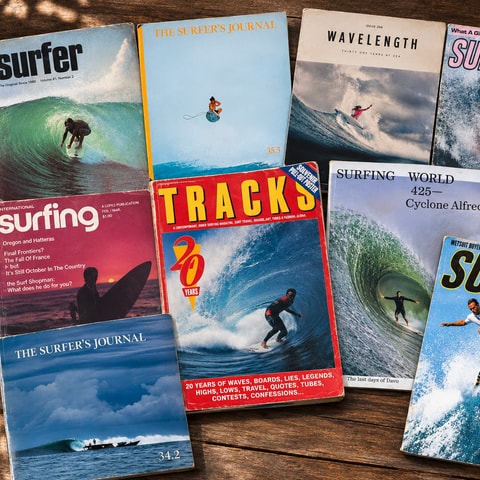 A new issue could stay on a bedroom floor or a surf-shop counter for months. Photographs were studied. Waves were examined for clues. Sometimes nobody knew exactly where a photograph had been taken, and that uncertainty was part of the attraction.
Surfer, Surfing World, Tracks, and later The Surfer's Journal did more than report on surfing. They helped construct an imaginary geography of it.
Then there were the films.
Movies passed from one surfer to another. VHS tapes wore out. Hollywood discovered the strange magnetism of surf culture. Faraway waves appeared on screens long before most people could dream of finding them on a map.
Today we can watch a wave ridden on the other side of the planet seconds after it happens.
Back then, an image might arrive months later.
And somehow, perhaps because there were fewer of them, some of those images stayed with people for years.
That story deserves its own journey.
For now, there is still an ocean outside.
The forecast is probably already open somewhere.
But every once in a while, it might be worth closing it for a moment and looking at the sea first.
Did you enjoy this post? Please support us by sharing it!