Following the Waves: An Algarve Surf Road Trip by Campervan
Follow our Algarve campervan road trip from Spain to Arrifana, exploring surf spots, coastal villages, wild beaches, local food and the Costa Vicentina.
By @shakanomad - 29 Oct 2026

Our plan was simple: drive from Spain into Portugal, follow the Algarve coast west and spend as much time as possible surfing. We had our boards, a campervan and a few places we wanted to explore. The rest would depend on the waves.
We entered Portugal through Ayamonte, crossed into the eastern Algarve and gradually made our way towards Sagres, Carrapateira and Arrifana. Along the way, we found fishing villages, beaches hidden between cliffs, good food and a coastline that changes completely as you turn towards the Atlantic.
This is the route we followed, along with a few things worth knowing if you're planning your own Algarve surf road trip by campervan.
From Spain to Portugal: Ayamonte, Manta Rota and Tavira
Crossing the Guadiana River from Ayamonte brings you into the eastern Algarve, where the landscape is noticeably different from the west coast. The beaches are longer and flatter, with wide stretches of sand, dunes and calmer-looking water.
We passed through Manta Rota, a coastal village with an extensive sandy beach. It's a lovely place to take a break, enjoy the sea or even spend the night at the parking overnight spot. This part of the Algarve is more sheltered from the North Atlantic swells, so although surfing is possible under the right conditions, it wasn't where we expected to find most of our waves.
Our next stop was Tavira, specifically the Continente market, to stock the campervan with Portuguese and Brazilian food. A supermarket stop might not sound like a travel highlight, but it's a useful one when you're living on the road. There was plenty to choose from, and the granes of coffee genuinely good.
Tavira itself is worth exploring if you have time. It's a town of traditional buildings, small streets and a riverside atmosphere, with access to the beaches and wetlands of the eastern Algarve. We were mainly focused on continuing west, but it's somewhere you could easily spend longer.
Praia do Vau, Portimão: Cliffs, Coves and Caves
Continuing towards Portimão, we stopped at Praia do Vau, and this is where the scenery starts to change.
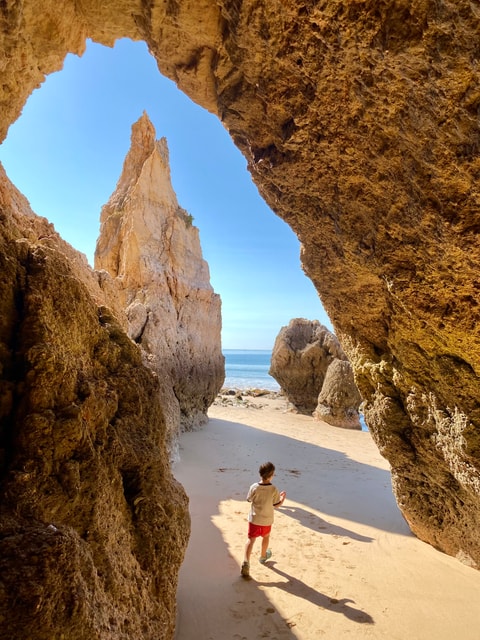 Golden and reddish limestone cliffs rise above the beaches, with small coves, rock formations and caves carved by the sea. Around Vau and the neighbouring beaches, you can walk along sections of the coastline and discover viewpoints over the Atlantic.
The contrast between the pale sand, the warm-coloured cliffs and the blue water makes this part of the Algarve particularly photogenic. It's worth spending some time here even if the surf forecast isn't promising.
Vau is generally more sheltered than the west-facing beaches further along our route. Its summer seawater temperatures are also usually warmer, making it a pleasant place for a swim when conditions are safe.
If you're exploring the cliffs, keep to established paths and avoid standing close to unstable edges. Rockfalls are a real concern along parts of the Algarve's limestone coastline.
Burgau and Figueira: Two Places Worth Slowing Down For
After Portimão, we continued towards Burgau, one of the villages we particularly wanted to visit.
Burgau: A Fishing Village by the Sea
Burgau is a small coastal village with whitewashed houses, narrow streets and a beach tucked between cliffs. The road descends towards the sea, where the village still retains much of its fishing character.
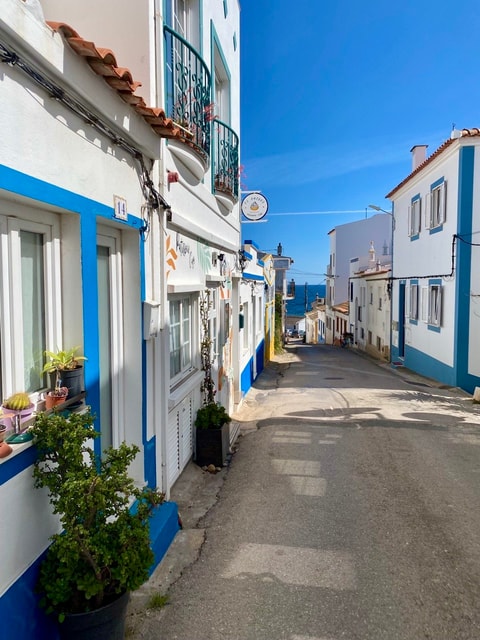 It’s the kind of place where you can park your campervan, wander through the village and explore at your own pace. You’ll find plenty of cafés and restaurants around the centre and near the beach, making it a lovely stop for a coffee or a leisurely meal. And although it’s not traditional local cuisine, I definitely have to recommend Indian Ocean Bites, a restaurant that’s well worth a visit!
Burgau is also close to the southern boundary of the Southwest Alentejo and Vicentine Coast Natural Park, which extends along this remarkable stretch of Portugal's coastline.
Surfing here is totally possible but it depends on the swell direction. The beach is protected from much of the northwest Atlantic energy and generally needs a suitable southerly swell to produce rideable waves.
Praia da Figueira: A Beach You Have to Walk To
Not far from Burgau, near the village of Figueira, you'll find Praia da Figueira, a small beach surrounded by natural cliffs.
There's no road directly down to the sand. Access involves walking approximately 900 metres from the parking area along a dirt path that crosses a valley towards the coast.
The beach has no permanent beach facilities or lifeguard service, so bring water and anything else you need. It's also worth checking the tide and sea conditions before walking down.
This is a lovely place to appreciate the quieter side of the Algarve. Not every stop on a surf trip needs to deliver waves; sometimes it's worth exploring a beach simply because it's there.
Sagres: Exploring the Algarve’s Atlantic Surf Coast
As you approach Sagres, the coastline opens up and the Atlantic becomes much more exposed. The cliffs are higher, the vegetation is lower and the wind plays a bigger part in your day.
What makes Sagres especially interesting for surfing is its position near the southwestern corner of mainland Portugal. Within a relatively small area, you can explore beaches facing different directions.
That matters because a beach exposed to a northwest swell may have waves while a south-facing beach remains nearly flat. When the swell becomes too powerful or the wind changes, another beach might offer more manageable conditions.
Some surf spots worth checking around Sagres include:
- Praia do Tonel: Close to Sagres, with exposure to Atlantic swell. A popular surf beach, although waves can become powerful and some areas have rocks.
- Praia do Beliche: A beach beneath steep cliffs, capable of producing strong waves when the swell and tide line up. Best approached with care, particularly on bigger days.
- Praia da Mareta: More sheltered from the dominant northwest swell. Often calmer, but it can produce surf when the swell reaches the south-facing coast.
- Praia da Cordoama and Praia do Castelejo: West-facing beaches north of Sagres, exposed to Atlantic swells and surrounded by impressive cliffs. Conditions can be demanding when the ocean gets bigger.
It's worth spending more than one day around Sagres if surfing is your priority. Check the forecast in the morning, look at the wind direction and compare a couple of beaches before deciding where to paddle out.
The area around Cabo de São Vicente is also worth visiting for its landscape and coastal views, especially if you want a break between surf sessions.
Carrapateira and Praia do Amado: Back to the Atlantic
North of Sagres, the road towards Carrapateira takes you deeper into the Costa Vicentina. This is one of the most distinctive stretches of our route, with open landscapes, winding roads, beaches surrounded by cliffs and far less urban development than the central Algarve.
Near the village of Carrapateira, Praia do Amado is one of the most recognised surf beaches in southern Portugal.
The beach is surrounded by dramatic layers of red, ochre and darker rock. From the viewpoints above, you can see the exposed coastline, the sand and the different peaks breaking along the beach.
Praia do Amado is a beach break where the waves depend on shifting sandbanks, swell direction, wind and tide. Surf schools operate here, and on smaller, suitable days it can be a place to learn or improve your technique. When bigger Atlantic swells arrive, however, the same beach can become challenging, with stronger currents and heavier waves.
Don't assume a beach is beginner-friendly simply because there are surf schools nearby. Always judge the conditions on the day.
If you have time, explore the nearby Praia da Bordeira and the coastal viewpoints around Pontal da Carrapateira. Bordeira has an enormous stretch of sand at low tide, backed by dunes and a river mouth that forms a lagoon. It's another interesting surf option, but also a great place for a walk.
The views around Carrapateira are worth the drive alone. You can see how different sections of the coastline have been shaped by the ocean, with steep cliffs, dunes and small valleys reaching the beach.
Arrifana: A Surf Bay Surrounded by Cliffs
Continuing north towards Aljezur, we reached Praia da Arrifana, another important stop on our Algarve surf route.
Arrifana is a long, curved beach sheltered by imposing cliffs, with houses above the bay and a small fishing harbour at its northern end. From the viewpoint near the old fortress ruins, you can see almost the entire bay and get a useful first impression of the conditions.
For surfers, Arrifana offers a different setup from Praia do Amado. Its curved coastline gives parts of the beach some protection from the wind and swell, although conditions vary across the bay.
On manageable days, the sandy sections can offer enjoyable waves for improving surfers and lessons. More powerful swells can create demanding conditions, particularly near the rocky areas and the northern end of the beach.
Arrifana is popular, so give other surfers space, respect priority in the water and take a little time to observe the lineup before paddling out.
The access road down to the beach is steep, and parking can be limited. With a campervan, it's sensible to check the parking arrangements above the bay rather than assuming you can drive all the way down.
Nearby Aljezur is also worth visiting for its old streets, castle and local food. It's a useful base for exploring Arrifana and other nearby beaches without having to move the campervan constantly.
When Is the Best Surf Season in the Algarve?
You can surf in the Algarve throughout the year, but the conditions change considerably between summer and winter. The west coast receives the most consistent Atlantic swell, while south-facing beaches generally need particular swell directions or enough energy to wrap around the headlands.
Autumn: September to November
Autumn is one of the best periods for an Algarve surf trip. Atlantic swells become more frequent, the summer crowds begin to thin out and the sea has not yet reached its winter temperatures.
September and October can offer a good balance between waves and comfortable weather, particularly for intermediate surfers. November generally brings more powerful swells and increasingly changeable conditions.
Winter: December to February
Winter is the main season for larger, more powerful surf. Storm systems in the North Atlantic send consistent swell towards Portugal, producing good waves but also days when exposed beaches become too dangerous for less experienced surfers.
This is an excellent time for confident surfers who know how to read forecasts, assess currents and choose appropriate spots. The sheltered beaches around Sagres can become useful alternatives when the western coastline is too exposed.
Expect cooler water, shorter days, occasional heavy rain and stronger winds.
Spring: March to May
Spring offers a mix of conditions. Atlantic swells are still common, but their size and consistency gradually change as summer approaches.
It's a good season to travel without the busiest summer crowds, and the surrounding hills and coastal vegetation become particularly colourful after the winter rains.
Summer: June to August
Summer generally brings smaller swells and more stable weather, which can be suitable for beginners when the sea is calm enough for lessons.
However, the Algarve's western coast is affected by the nortada, the northerly and northwesterly winds that often become stronger during the afternoon. These can make exposed surf spots choppy even when the swell looks promising.
Early sessions are often worth checking before the wind increases. Summer is also the busiest tourism season, so expect more people around the popular beaches and surf schools.
How Cold Is the Ocean in the Algarve?
Don't let the warm Algarve sunshine fool you. The Atlantic can feel surprisingly cold, especially on the western coast.
Water temperature varies depending on the season, wind and beach orientation. For example, Portugal's official tourism information reports average summer seawater temperatures of approximately 17–18°C at Praia do Amado and Arrifana, compared with 20–22°C at Praia do Vau on the south coast.
In winter, seawater temperatures commonly fall into the mid-teens, roughly 15–17°C, although conditions vary.
For surfing, a 3/2 mm full wetsuit is a useful summer starting point on the west coast, while a 4/3 mm suit is generally a better choice for winter and colder days. Depending on your tolerance for cold and how long you surf, you may want additional insulation.
Cold water can also be influenced by upwelling, when winds help bring colder water from deeper layers towards the surface. This is one reason a hot day in August doesn't necessarily mean warm water around Sagres or Carrapateira.
How to Find the Right Waves
Having a campervan gives you the flexibility to move between surf spots, but driving from beach to beach without checking the conditions can waste a lot of time.
Surf forecasting sites such as surf-forecast.com can help with planning, but observations at the beach are just as important. Speak to local surf schools when you're unfamiliar with a break, and don't enter the water if the conditions exceed your ability.
Nature Along the Costa Vicentina: More Than Surf Beaches
One of the things that makes this road trip interesting is how much natural diversity you encounter between Burgau, Sagres, Carrapateira and Arrifana.
Much of this area belongs to the Southwest Alentejo and Vicentine Coast Natural Park, which protects cliffs, dunes, coastal scrubland, river mouths and a remarkable variety of plants and wildlife.
Birds and Coastal Wildlife
Keep an eye on the cliffs and the sky. The Costa Vicentina is especially important for seabirds, birds of prey and migrating species.
One of its most remarkable inhabitants is the white stork. Unlike most storks, which typically nest on buildings or inland structures, some of the white storks along this coast build their nests directly on offshore rocks and sea cliffs.
You may also encounter falcons, gulls, swifts and other coastal birds. The Sagres region is an important area for bird migration, particularly in autumn.
The natural park also supports otters in some waterways and coastal habitats, although sightings are rare. At low tide, rocky pools can contain small fish, crabs, sea anemones and other marine life.
Coastal Plants and Wildflowers
The vegetation here is shaped by strong winds, salty air and thin soils. Along the cliffs you'll find low shrubs, grasses and plants adapted to difficult conditions.
Among the characteristic plants of the area are rockrose, wild lavender and coastal thyme, together with rare species that exist only in parts of southwestern Portugal.
In spring, the landscape becomes much greener and many of the coastal plants flower. The dunes and cliff plateaus can be particularly interesting for anyone who enjoys nature photography or walking.
These habitats are fragile. Stay on marked paths and wooden walkways, especially near dunes and nesting areas. Avoid disturbing wildlife and don't drive onto unmarked tracks or vegetation to reach a viewpoint.
If you enjoy walking as much as surfing, explore sections of the Rota Vicentina, a network of trails crossing the region's coastal and inland landscapes.
Campervan Life: Where to Sleep and Find Services
One of the most practical tools we recommend for travelling through Portugal by campervan is park4night.
The app helps you discover campsites, authorised motorhome areas, parking locations and places offering useful services along your route. You can look for drinking water, wastewater disposal, toilets and other facilities, depending on the location.
It's particularly helpful when you're moving between surf spots and don't want to spend too much time searching for somewhere to stop at the end of the day.
One important point: a location appearing on park4night doesn't mean you're automatically allowed to sleep there. Always check signs, local regulations and whether overnight stays are expressly authorised.
In Portugal, overnight stays by campervans and motorhomes are generally prohibited outside expressly authorised places in protected areas, Natura 2000 sites and areas covered by coastal management plans. Elsewhere, the general rule may permit up to 48 hours in the same municipality if no local regulation says otherwise, subject to the vehicle and other legal conditions.
This matters especially along the Costa Vicentina, where many of the beaches and surrounding landscapes are protected. Use designated motorhome areas or campsites for overnight stays, and never empty wastewater outside appropriate facilities.
For further information, consult Visit Portugal's official campervanning guidance.
Food Along the Way: Portuguese Flavours After Surfing
Food is part of any good road trip, particularly when you've been in the water for a couple of hours.
Our stop at Continente Tavira was a chance to stock up on Portuguese and Brazilian groceries before heading west. Having food in the campervan makes it easier to organise your day around the surf, especially when you're visiting more remote beaches.
But don't spend the whole trip cooking. The Algarve has a strong fishing tradition, and there are plenty of local dishes worth trying along the route.
Look for freshly grilled fish, sardines, octopus, seafood rice or a traditional cataplana, a dish prepared in a distinctive covered pan, often with fish or shellfish.
Portimão is particularly associated with grilled sardines, while around Aljezur you'll find the region's famous sweet potatoes, used in both savoury dishes and traditional pastries.
A simple lunch in a local restaurant, some Portuguese bread and a good espresso can be just what you need between sessions.
It's also worth buying from local bakeries, markets and smaller shops whenever you can. They offer another way to discover the region beyond the beaches.
What About Faro and Albufeira?
Both Faro and Albufeira are possible stops if you want to explore more of the Algarve's towns, restaurants and cultural attractions.
Faro is a useful gateway to the Ria Formosa and its islands, while Albufeira is known for its beaches and busier tourism scene.
We didn't make either a major part of our trip. Our priority was getting west and spending more time around the surf beaches, so these were places to skip or pass through quickly rather than build the journey around.
If you have extra time, they're easy additions to a wider Algarve itinerary. If surfing is your main reason for travelling, we'd give those extra days to Sagres, Carrapateira or Arrifana instead.
Would We Recommend This Algarve Surf Road Trip?
Absolutely, especially if you enjoy combining surfing with travelling by campervan.
The route from Ayamonte to Arrifana offers far more than a collection of surf spots. You move from the long sandy beaches of the eastern Algarve to limestone cliffs, small fishing villages and finally the exposed Atlantic coastline of the Costa Vicentina.
Some places are worth visiting for the waves. Others, like Burgau and Figueira, are worth the stop regardless of the forecast.
We wouldn't try to fit everything into a rigid daily schedule. Allow enough time to check the conditions, choose where to surf, enjoy the local food and explore a little away from the beach.
That's what we liked about doing this journey together in a campervan: we could follow the coast and make surfing the priority without having to rush through every place.
Did you enjoy this post? Please support us by sharing it!